

Struggling to manage Internet costs for your small business? Here are ways to optimize your Internet usage.
Struggling to manage Internet costs for your small business? Here are ways to optimize your Internet usage.
Due to the pandemic, most businesses globally are working remotely, and as a result, there is increased demand for Internet connectivity. However, increased demand has come alongside higher costs. Internet service is an essential tool for improving competitiveness and efficiency, reaching customers, and interacting with vendors, and with the Covid-19 pandemic, it has become even more critical. Business owners in Rwanda are already struggling to maintain their businesses afloat are now also grappling with this added expense.
- Determine the data speed and reliability you need
Internet speeds are determined by how much data the connection can download or upload per second—often referred to in Mbps (megabits per second) or Gbps (gigabits per second). The speed and reliability also depend on your location and the data plan you have. Business owners must engage service providers to test data speeds at their locations; this helps you understand whether the connection will be fast enough and offer a performance quality suited for services and applications you use. It also helps you avoid overspending. Businesses can also take advantage of several tools available on the Internet to evaluate data speed needs, such as https://www.verizonwireless.com/freedom/datacalculator.html.
- Choose an appropriate Internet connection
There are different types of Internet connections, offering various performances in terms of data speed and mobility. These include optical fibre, cable, satellite, WiFi, and 3G/4G mobile networks. While the different types of connections are associated with various pros and cons, the choice of connection typically depends on your requirements. In terms of reliability and link uptime, broadband WiFi Internet and Mobile WiFi routers (Mifi) serve as a clear leader against using 3G/4G mobile networks. Mifi routers are the best option for businesses having less than five users who are working remotely. For companies with more than five workers, broadband Internet provides a suitable connection. It allows you to connect up to 10 devices at the same time.
- Reduce unnecessary streaming
Streaming of any kind (music, videos, etc.) increases data usage dramatically. Video streaming is especially something to be cautious about when you need bandwidth for other tasks such as online marketing or virtual meetings. When using apps like Facebook or YouTube, ensure to switch off ‘auto play’ and decide which videos you want to open and watch. You can also cut back on data usage from streaming by watching videos in standard definition instead of high definition. When watching a video, you can select the data usage options auto or low, which consume less data than watching in medium or high that consume more data. Businesses can also consider restricting users to limit streaming, ensuring they instead use bandwidth for more critical tasks for business operations.
- Schedule data usage according to business activities
Business activity usually rises and falls according to predictable schedules. Many companies operate on a nine-to-five schedule, while some experience peak activity when the sunsets. Scheduling activities and data usage according to this pattern allows further optimization of digital resources. Suppose your business operates on a nine-to-five basis. Here, you can limit backups and software updates until the evening when operations are done and save a particularly intensive update or backup for the weekend instead. A company that has activities concentrated in the evenings and on weekends should consider the opposite schedule. These backups and updates are critical; remember, if your software isn’t up to date, you can suffer from seriously decreased performance, and you may also risk losing important information if data backup is not done regularly.
The actions above are not exhaustive on optimizing your Internet usage, but they are a strong starting point. Let us know how they work for you via this email: smeresponseclinic@gmail.com


SME RESPONSE CLINIC ANNOUNCES BUILDING BACK HEALTHIER SERIES WITH UPCOMING RADIO SHOW

The SME Response Clinic is pleased to announce that we are launching the Building Back Healthier Series, which focuses on supporting business owners and entrepreneurs with insights to positively impact wellbeing.
The series will launch with a radio show on 18 October at 7:30 pm. Please join us for the discussion, Supporting Entrepreneurs’ Wellbeing during COVID-19, on KT Radio’s Ubyumva Ute? show.
The radio show will feature expert psychologists from the Geruka Healing Center in conversation with entrepreneurs who will share their experiences. Experts will provide insights on best practices on self-care to support day-to-day business operations as well as information on existing support services for individuals experiencing difficulties.
Join us as we work to
- Raise awareness around common wellness issues for entrepreneurs and business owners
- Identify emerging challenges for entrepreneurs and business owners resulting from the COVID-19 pandemic
- Share knowledge and insights to promote personal self-care and wellbeing
- Encourage sharing of knowledge and experiences among entrepreneurs and experts in the wellness community
- Share information on existing support services for individuals experiencing difficulties
Speakers
Dr Vincent Sezibera – Clinical Psychologist & Director, University of Rwanda/Centre for Mental Health
Divine Uwase – CEO & Founder, Sharama Events & Tours
Jeannette Umutoniwase – Founder, Inzira Dreams Network

Thinking of starting a business or growing your startup but unsure of where to start? Develop a Business Model Canvas
Thinking of starting a business or growing your startup but unsure of where to start? Develop a Business Model Canvas
Are you an entrepreneur thinking of starting a business or a business owner in the startup phase with plans to take your business to the next level? The Business Model Canvas is an entrepreneurial tool that enables you to visualize, design, and reinvent your business model. Developed by Swiss business theorist and author Alexander Osterwalder, the tool can help business owners develop a clear view of their value proposition, operations, customers, and finances. As a small business owner, you can use it to identify how the different components of your business relate to each other. That’s powerful when deciding where you need to focus your time and attention as you start and grow your business.
While business plans can be helpful when starting or growing a business or necessary to obtain financing or investment, the business model canvas can provide entrepreneurs with an easier starting point. Business model canvas is precise and structures business models more quickly than developing a business plan, which can take several months to write.
The canvas includes nine building blocks with main questions for each as follows:
- Key partners —Who are the buyers and suppliers to relate with? What other alliances will help you accomplish core business activities and fulfil your value proposition?
- Key activities—What are the most important actions you must engage in to fulfil your value propositions, strengthen customer relationships, optimize revenue streams, etc.?
- Key resources—What resources do you need to optimize value for your customers and sustain your business?
- Value propositions—What products and services will you offer to meet the needs of your customers? How will your business be different from your competition? What challenges will you solve for your customers?
- Customer relationships—What types of relationships will you forge with your customer segments? What are the relationship expectations of each customer segment?
- Customer segments—What sets of customers will you serve? Which are most important to your business?
- Channels—Through what means will you reach your targeted customers and deliver your products and services to them? Which are most cost-effective?
- Cost structure—What are the essential costs your business will face? Which resources and activities will cost the most?
- Revenue streams—How much will you charge for your products and services? What are customers willing to pay for? How will customers pay?
Embracing the tool can help entrepreneurs easily identify gaps during planning, visualize what is important, and provide context for next steps.

Updated Government COVID-19 Preventive Measures
The Latest Government COVID-19 Preventive Measures
On 22st September 2021, the government reviewed and issued new COVID-19 preventive measures. The new measures issued will take effect from 23rd September and will last till 13th October 2021, where the cabinet will review them upon a health assessment.
Below are the updated government measures.
- Movements are prohibited between 11:00 pm and 04:00 am in the city of Kigali. For the rest of the country, movements are prohibited between 9 pm, and 4 am with businesses closing by 8 pm. However, for districts including Burera, Gicumbi, Kirehe, Ngoma, Nyagatare, Nyamasheke, Nyaruguru and Rwamagana where movements are prohibited between 8 pm and 4 am, and businesses close by 7 pm.
- Public and private offices will continue with essential staff but not exceeding 75% capacity while other employees continue to work from home. Private business also resumed with essential staff not exceeding 75%
- Physical conferences are allowed but should not exceed 50% of venue capacity, and event organizers must comply with all COVID-19 preventive measures, including a negative COVID-19 test results required for all participants taken within 72 hours before the meeting.
- Arriving passengers at the airport must present a negative COVID-19 PCR test taken within 72 hours before departure.
- Public transport will continue to operate at 75% capacity with strict adherence to the health guidelines (social distancing, open bus windows for proper ventilation, and proper mask-wearing). Motos and bicycles will continue to comply strictly with the health guidelines (disinfecting passenger’s helmets).
- Malls and markets will continue to operate with only essential vendors not exceeding 50% capacity of registered traders.
- Tourism will continue with strict adherence to COVID-19 health guidelines. This includes hotels, tour operators, and transport services assisting guests.
- Individual and non-contact sports activities will continue with strict adherence to health guidelines. Gyms and fitness centers will continue progressively while adhering to detailed guidelines from the Ministry of Sports.
- Events and gatherings, including concerts, festivals, and exhibitions, will be held in designated or approved venues such as outdoor tents will continue. All participants must be vaccinated and test possess negative COVID 19 test results taken within 72 hours before the event
- Gaming activities shall resume gradually while adhering to detailed guidelines from the Ministry of Trade and Industry.
These measures will be reviewed after two weeks upon a health assessment. For more detailed COVID-19 measures, visit: Office of the Prime Minister

20 September Deadline for the Ecobank Fintech Challenge – Apply Now

20 September Deadline for the Ecobank Fintech Challenge – Apply Now
Ecobank has launched the Ecobank Fintech Challenge to identify and partner with FinTechs that are ready to scale. Ecobank will provide successful applicants with support and access to opportunities across Ecobank’s 33 African markets.
The Ecobank Fintech Challenge is open to all Fintechs on the African continent. It will offer participants the opportunity to participate in Ecobank’s FinTech innovation fair and join the Ecobank FinTech fellowship. Other potential benefits for selected firms include:
- Access to 33 markets Stand a chance to be among the top three winners at the challenge awarded with $15000, $12000 and $10000 cash prizes, respectively.
- An opportunity to partner with Ecobank locally in any of Ecobank’s 33 country ecosystem.
- Access to a dedicated team to support FinTechs with Ecobank’s API test to enable them to improve their products for the pan-African market.
- Access to a vast network of global and African accelerators as well as potential investors and mentors.
- Potential integration with Ecobank’s existing digital offerings such as Ecobank Omni, Ecobank electronic financial supply chain (eFSC), Ecobank Xpress, Ecobank Mobile APP or USSD, MasterPass QR, mVisa & mCash.
To qualify, FinTechs should make sure their products address one or more specific pain points, including customer experience, financial inclusion, credit scoring, ecosystem aggregation, internal tools, payments or any other relevant product categories.
Interested firms can apply by sending details of their product and a demo before 20 September 2021.
For more information about the challenge and application details, visit: Ecobank Fintech Challenge 2021
Are you a young entrepreneur or start-up in the tourism and hospitality sector? Apply for the Tourism Incubator Program!
Are you a young entrepreneur or start-up in the tourism and hospitality sector? Apply for the Tourism Incubator Program!
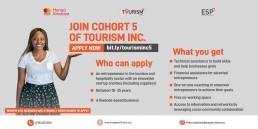
Entrepreneurial Solutions Partners (ESP), in partnership with the Mastercard Foundation under its Hanga Ahazaza program, has launched its fifth call for applications for young hospitality and start-up businesses to join the Tourism Inc. incubator program. Twenty-five applicants will be selected for the program and receive skills-building, seed funding, and access to a co-working space along with information and networking opportunities.
The tourism and hospitality sector is a significant contributor to Rwanda’s economic development and was among the most affected by the COVID-19 pandemic. With this program, young entrepreneurs and start-ups will have access to support to enable them to bounce back from the effects of COVID and prosper in a post-COVID business environment.
Interested applicants must meet the following criteria to apply:
- Must be a start-up (or have a start-up idea) in the tourism and hospitality sector (or be a supplier to the industry).
- Must be between 18 and 35 years of age.
- Must be based and operating in Rwanda.
- Women entrepreneurs are highly encouraged to apply.
Apply here.
ESP provides consulting and strategic advisory services to diverse clients, including governments, businesses, and development partners in Africa. It focuses on supporting innovative models and offers leadership training and entrepreneurial boot camps. ESP aims to enable innovative, scalable, and profitable enterprises to build prosperity.

Are you interested in selling online? Register for the virtual e-commerce forum from ECOM Africa!
Are you interested in selling online? Register for the virtual e-commerce forum from ECOM Africa!
Join ECOM Africa on September 21, 2021 to learn how to start or improve your online sales. Through the forum, businesses who are not yet conducting operations online will benefit from insights on ways to break into e-Commerce with lowerupfront costs.
Businesses whose operations are already digital will learn more about online merchandising , selling tools, market outlets, and operational strategies that can improve their existing sales..
The event includes speakers from development partners and diverse companies from East Africa, and will run from 9:30 to 17:30.
To register, visit: ECOMEASTAFRICA

Are you interested in business consulting services to address a business challenge related to going digital? Register for the Digital for Impact programme before 13th September 2021!
Are you interested in business consulting services to address a business challenge related to going digital? Register for the Digital for Impact programme before 13th September 2021!
The London Business School, in collaboration with the Growth Movement, a United Kingdom-based social enterprise, seek to support SMEs in Rwanda to address challenges post-COVID19 through their Digital for Impact programme. The programme will connect SMEs in Rwanda with top student consultants from the London Business School for business advisory services. Through the programme, SMEs in Rwanda will be assigned five business consultants to support them with tangible business solutions and recommendations to grow and pivot their enterprises. Additionally, SMEs will have the opportunity to network with London Business School’s extensive network of alumni and corporate partners and will earn a programme certificate from the institution. To be eligible for this opportunity, the business should:
- Be located in Rwanda or Uganda
- Have five or more employees Be fluent in English, have access to great internet and computer
- Be able to access virtual communication tools like Zoom, Webex, and others
- Have a digital-related opportunity or challenge
- Be dedicated to improving your business and outline a specific business challenge or project for the duration related to the “Digital for Impact” theme
- Be committed to completing all the sessions with your business consultant team
For more information about the programme: LBS Programme.
To apply for this programme: Application Form

Koroshya uburyo bwo gukora inyemezabuguzi
Koroshya uburyo bwo gukora inyemezabuguzi
Nubwo gukora inyemezabuguzi bishobora kuba atari cyo gice cy’ubucuruzi gishimishije kurusha ibindi, gukora inyemezabuguzi ni ingenzi ibyo ari byo byose kugira ngo sosiyete iyo ari yo yose ibashe kugumya gukora. Kubera ko icyorezo cyateye imbogamizi nyinshi mu micungire y’imikoreshereze y’amafaranga, ubu ni ingenzi kurusha mu bihe byose byahise, kugira uburyo bwo gukora inyemezabuguzi bukora neza. Hari uburyo butatu bwo kunoza imicungire y’inyemezabuguzi yawe.
- Gushyiraho uburyo bwo kwishyura bwumvikana
Mbere yo gukora amasezerano cyangwa kugira ubwumvikane mu bijyanye no gukora ubwishyu n’abaguzi bawe, ugomba kubasobanurira uburyo wifuza ko ubwishyu bwakorwa na politiki yawe. Urugero, niba ibyo wifuza ari uko wakwishyurwa mu minsi 15 umaze gutanga inyemezabwishyu, bibamenyeshe mbere. Ibi bifasha abakiriya bawe kudahura n’ibibazo no kudacibwa amafaranga mu buryo butunguranye kandi butabashimishishije mu gihe babonye inyemezabuguzi. Gushyiraho iki kigero cyo gukorera mu mucyo kandi bifasha ikigo cy’ubucuruzi kubaka imikoranire ihamye hagati yacyo n’abakiriya bacyo.
- Menya abakiriya bawe
Kugira ngo ubashe kwishyurirwa ku gihe no mu buryo bukwiye, ni ngombwa kumva imyitwarire y’abakiriya bawe n’ingorane zabo n’ibyo bakeneye. Ese bagira igihe runaka mu cyumweru cyangwa mu kwezi bishyurirwaho amafaranga n’umukoresha cyangwa n’abakiriya babo bwite? Ese bumva bifuza kwishyura bakoresheje amafaranga cyangwa bakoresheje ikoranabuhanga? Kugirana ikiganiro kigufi n’abakiriya bawe bishobora gutuma ubasha guhuza uburyo bwawe bwo kwishyurwa n’uburyo babonamo amafaranga ndetse n’uburyo bifuza kujya bishyura; ibyo bikazagufasha kwishyuza amafaranga bakugomba. Ibyo kandi bishobora kugufasha kumva igihe abakiriya bakeneye ko ubaha ibindi bicuruzwa cyangwa izindi serivisi nshya.
- Koresha ikoranabuhanga
Kubera ko ubucuruzi butangiye kugenda bukoresha ikoranabuhanga, sosiyete nyinshi z’ubucuruzi ziba zitegereje kwishyurwa hakoreshejwe uburyo bw’ikoranabuhanga kuko buzifasha kwishyurwa igihe icyo ari cyo cyose n’ahantu aho ari ho hose. Gushyiraho uburyo bwo kwishyurwa bukoresha ikoranabuhanga bituma umuntu adatakaza umwanya mu gukora inyemezabwishyu, ibyo bigatuma yibanda cyane ku yindi mirimo y’ingenzi. Ibisubizo bikoresha ikoranabuhanga bishobora kandi gufasha umuntu kuzigama amafaranga asanzwe akoresha mu bijyanye no kugeza ibicuruzwa ku baguzi, amafaranga y’impapuro cyangwa amafaranga agenda ku bakozi b’inyongera cyangwa kuri gahunda zijyanye n’uburyo bwo gukora inyemezabuguzi.
Bumwe mu buryo bw’ingenzi bukoreshwa mu gukora inyemezabuguzi hakoreshwa ikoranabuhanga burimo Zoho Invoice na Pesapal igufasha gushyiraho uburyo bwo kwikoresha , gukurikirana, no kugenzura ibyerekeranye n’ubwishyu.
Streamlining the invoicing process
While invoicing may not be the most enjoyable part of running a business, it is crucial to keep any company running. With the pandemic creating many challenges in cash flow management, it is now more important than ever to have a strong invoicing system. Here are three tips to improve your invoice management.
1. Establish clear payment terms
Before entering into a contract or payment agreement with a client, make sure to explain your payment terms and policies to them. For example, if your terms are to receive payment within 15 days of issuance, let them know that up front. This allows your clients to avoid unwelcome surprises and fees when they receive invoices. Establishing this level of transparency also helps to build a stronger relationship with your clients.
2. Know your clients
To ensure you receive payments in a timely and convenient manner, it is important to understand how your client behaves and their concerns and needs. Do they have a particular time of the week or month when they receive payment from an employer or their own clients? Do they prefer paying via cash or mobile money? Having a brief conversation with your clients can allow you to tailor payment terms to their cash flows and preferred methods of payment, which will make it easier for you to collect what is due. This can also help you understand when clients might require new deliveries of your product or services.
3. Go digital
As businesses start shifting online, many companies expect digital payment solutions that allow them to make payments at any time from anywhere. Providing an online payment solution can save time in the invoicing process, allowing you to focus more on other important tasks. Digital solutions can also help you increase savings by reducing your expenses on delivery fees, paper costs, or additional staff or programs to handle the invoicing process.
Some useful online invoicing platforms include Zoho Invoice and Pesapal, that help you automate, track and organize payments.

SME Response Clinic iri gufatanya na Banki ya KCB


SME Response Clinic iri gufatanya na Banki ya KCB
SME Response Clinic yafatanyije na Banki ya KCB Rwanda mu bikorwa byayo bikomeza byo kwegereza ba rwiyemezamirimo ibigo by’imari bitanga serivisi z’imari n’izitari iz’imari kugira ngo babashe gukemura ibibazo bafite muri ibi bihe bya COVID-19 na nyuma yayo.
Binyuze muri ubu bufatanye, ba rwiyemezamirimo bazajya babonera amakuru ku gihe ajyanye n’ibikorwa by’imari bya KCB na serivisi zitari iz’mari z’iyo banki nka Biashara Club itanga serivisi z’indobanure, amahugurwa, inama nyunguranabitekerezo ku bijyanye n’ubucuruzi, n’amahirwe yo guhuza abantu n’abandi. Binyuze muri ubwo bufatanye, abasura SME Response Clinic bazahabwa umurongo wa telefoni bashobora gukoresha mu buryo butaziguye bavugana n’ikigo. Uwo murongo ni: +250788140000.
Tunejejwe n’amahirwe ubu bufatanye bushobora kugeza ku kigo cy’ubucuruzi cyawe kandi tubijeje ko buri gihe tuzajya tubagezaho amakuru mashya ku bijyanye n’ibicuruzwa na serivisi za KCB!
The SME Response Clinic Partners with KCB Bank
The SME Response Clinic has partnered with KCB Bank Rwanda as part of our ongoing efforts to bring entrepreneurs even closer to financial institutions that offer access to finance and non-financial services to meet business needs through COVID-19 and beyond.
Through this partnership, entrepreneurs will have access to timely information on KCB Bank’s financial products as well as non-financial services such as KCB Bank’s Biashara Club, which features preferential offerings, trainings, business workshops, and networking opportunities. Through the partnership, SME Response Clinic visitors will also have a direct line to the institution at +250788140000.
We are excited about the opportunities this partnership can create for your businesses, and we look forward to providing you with regular updates on KCB Bank’s products and services!