


Interested in taking advantage of a training opportunity to help your business? Here are some tips for maximizing your chances to participate.
Interested in taking advantage of a training opportunity to help your business? Here are some tips for maximizing your chances to participate.
As an entrepreneur, seeking out training opportunities can be a valuable step towards enhancing your skills and knowledge, which in turn can help you grow your business. Unfortunately, most opportunities have limited spots and fierce competition, so maximising your chances of being selected for such programs is crucial. In this article, you’ll find five essential tips to increase your likelihood of securing a business development training opportunity.
- Thoroughly research the organization or institution offering the training: Before applying, gain a deep understanding of their mission, values, and the specific focus of their training. This knowledge will enable you to tailor your application to align with their objectives, increasing your chances of standing out as a suitable candidate. Most opportunities will focus on a specific sector or stage of business growth.
- Highlight relevant experience and skills: When applying, emphasize your relevant experience and skills that demonstrate your ability to drive business growth. Showcase any previous entrepreneurial ventures, leadership roles, or projects highlighting your expertise. By highlighting your accomplishments, you can effectively convey your potential to not only learn but also contribute to the program and the organization. If you do not have relevant experience or skills, express your willingness and demonstrate commitment to learn.
- Craft a compelling application: Take the time to create a well-written and tailored application that clearly articulates your motivation for applying. Explain how the training opportunity aligns with your goals and aspirations. Use specific examples and achievements to support your claims, showcasing your ability to apply business development strategies effectively. A compelling application will make you stand out from the competition.
- Network and seek recommendations: Leverage your professional network to gather information about the organization or institution offering the training opportunity. Seek recommendations from mentors, colleagues, or industry professionals who can vouch for your skills and potential. A strong recommendation can significantly enhance your application and increase your chances of being selected.
- Prepare thoroughly for interviews or assessments: If the selection process includes interviews or assessments, it’s crucial to prepare thoroughly. Research common interview questions related to business development and practice your responses. Familiarize yourself with case studies or business scenarios that may be presented during assessments. By being well-prepared, you can confidently showcase your knowledge and skills, leaving a lasting impression on the selection committee.
Securing a business development training opportunity can be a game-changer for entrepreneurs looking to enhance their skills and drive business growth. Do not be discouraged if you fail to land an application for an opportunity. Learn how to bounce back from rejected applications and learn from the mistakes. With careful planning and a proactive approach, you can increase your likelihood of being selected for a business development training opportunity. Good luck!


Do you have an innovative solution that contributes to sustainable development? Apply for funding from the Commonwealth Secretary-General’s Innovation for Sustainable Development Awards before 15 October 2023
Do you have an innovative solution that contributes to sustainable development? Apply for funding from the Commonwealth Secretary-General’s Innovation for Sustainable Development Awards before 15 October 2023
The Commonwealth Secretariat, an intergovernmental organisation that supports member countries and coordinates Commonwealth activities invites applicants for the Commonwealth Secretary-General’s Innovation for Sustainable Development Awards. The aim of the Awards is to recognize and reward outstanding innovations that contribute to sustainable development within the Commonwealth member countries. These awards serve as a platform to showcase innovative ideas, technologies, and initiatives that have the potential to create positive social, economic, and environmental impacts.
Winning the Awards offers several benefits, including:
- Global recognition and visibility for the awarded innovation
- Increased opportunities for investment, partnerships, and collaborations
- Platform for knowledge sharing and learning among innovators and stakeholders
- Amplified reach and impact of the innovation
- Potential for further scaling up and replication in different contexts
Interested applicants should have innovative solutions that meet the following criteria:
- Implementation within a Commonwealth member country (Rwanda included)
- Contribution to the sustainable development goals of the specific nation
- Demonstrated clear and measurable impact on sustainable development
- Addressing social, economic, or environmental challenges
- Scalable, replicable, and potential for long-term sustainability
- Showcasing creativity, originality, and effectiveness in problem-solving
- Open to individuals, organizations, and partnerships across sectors
For more information and application details, visit the Awards Platform

Are you an early-stage social enterprise interested in scaling? Apply for the BfE Incubation Programme before 1 October 2023
Are you an early-stage social enterprise interested in scaling? Apply for the BfE Incubation Programme before 1 October 2023
Bridges for Enterprise, a non-profit organization that provides pro bono advisory services to social innovators in the developing world, invites applicants for the BfE Incubation Programme. The programme lasts for 6 to 8 months, with multiple implementation stages customized to best support participants to scale their social enterprises. Applications are due 1 October 2023.
Through the programme, participants will be offered consulting and financial advisory services as well as optional legal and technical advisory services. Consulting, financial and legal advisory services will each have a 3 to 4 month timeline, while the technical advisory services will have a timeframe of 3 to 6 months.
The programme will accept social enterprises that demonstrate the following:
- A unique minimum viable product (MVP) that addresses one or more key development challenges
- Revenue-generating business model
- Generates positive environmental or social impact in the communities served
- Leadership team that demonstrates commitment
Additionally, the programme is suitable for social enterprises which fulfil the following:
- Be a for-profit or non-profit social enterprise
- Be an early-stage start-up at the pre-seed or seed stage
- Have an existing product or service and have started earning revenue
- Be legally established in Africa, Asia, Latin America or the Middle East
- Demonstrate a clear path to financial returns and impact
To apply for this programme, visit: Submit Application
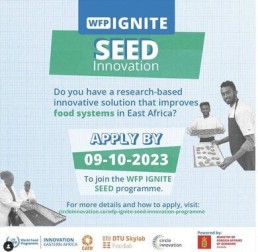
Do you have a research-backed innovation addressing food security? Apply for funding and mentorship from the WFP Ignite SEED Innovation Programme before 9 October 2023.
Do you have a research-backed innovation addressing food security? Apply for funding and mentorship from the WFP Ignite SEED Innovation Programme before 9 October 2023.
The World Food Program Ignite Innovation Hub invites early-stage innovators with research-backed ideas in the food systems to apply for the Ignite SEED Innovation Programme. The ten-month Program aims to help innovators develop and scale their solutions to address food security and improve climate resilience for local communities.
Selected participants will receive the following benefits:
- Mentorship from experienced entrepreneurs and food systems experts
- Access to WFP’s network of partners and stakeholders
- Funding to support prototyping, testing, and scaling their solutions
- Training and workshops on business development, marketing, and fundraising
Interested participants must meet the following criteria to apply:
- Have a research-backed idea or invention in the food systems sector
- Have at least two team members based in Kenya, Uganda, Rwanda, Ethiopia, or Somalia
- Be interested in transforming their idea into a venture
- Be passionate about disrupting food systems to achieve zero hunger
- Be available for program activities for the duration of the innovation program, including in-person and online sessions
- Female entrepreneurs and non-academic innovators are specifically encouraged to apply
Innovators interested in the Program must submit a proposal outlining their idea, team, and how they plan to use the Program to scale their solution. To apply, visit: Application form

Do you have a health tech solution to improve the lives of children? Apply for the UNICEF Innovation Fund before 20 October 2023
Do you have a health tech solution to improve the lives of children? Apply for the UNICEF Innovation Fund before 20 October 2023
The United Nations Children’s Fund (UNICEF) has launched a new funding opportunity for health tech startups that use cutting-edge technologies to improve the lives of children. The UNICEF Innovation Fund is offering up to US$100,000 in equity-free funding to early-stage startups that are registered in one of UNICEF’s program countries.
The Fund is particularly interested in startups that are using artificial intelligence (AI), machine learning (ML), data science, blockchain, and extended reality (XR) to address challenges in child health, nutrition, and mental health. Specific areas of interest include:
- Developing new diagnostic tools and treatments for childhood diseases
- Improving access to healthcare in remote and underserved communities
- Using technology to prevent child abuse and neglect
- Promoting mental health and well-being among children
Startups eligible for funding must have a working prototype and a commitment to open-source licensing. Female and youth-led/founded startups are encouraged to apply.
Successful participants will receive the following benefits:
- Up to US$100,000 in equity-free funding
- Access to UNICEF’s network of experts and partners
- Support for developing and scaling your solution
- Increased visibility for your startup
To apply for the Fund, visit Application

Are you a woman entrepreneur struggling with access to finance, markets and networks? Apply for the IFC She Wins Africa program before 15 September 2023
Are you a woman entrepreneur struggling with access to finance, markets and networks? Apply for the IFC She Wins Africa program before 15 September 2023.
The International Finance Corporation (IFC) invites applicants for the She Wins Africa program, launched to support women entrepreneurs across sub-Saharan Africa. The She Wins Africa program addresses the challenges women entrepreneurs face in accessing finance, markets, and networks. The program provides participants with training, mentorship, and networking opportunities to help them build skills and knowledge to build and grow their businesses.
The program includes the following components:
- Investment readiness training: Participants will receive training on how to pitch their businesses to investors, develop financial projections, and build robust business plans.
- Mentorship: Participants will be matched with experienced mentors who can provide guidance and support.
- Networking opportunities: Participants will have the opportunity to connect with other women entrepreneurs, investors, and business leaders.
Interested participants must meet the following criteria:
- Be for-profit businesses.
- Have a female founder or co-founder.
- Be based in sub-Saharan Africa.
- Have been operating for at least one year.
- Have a clear business model and financial projections.
Successful applicants will receive the following benefits:
- Increased access to finance: The program provides participants with training on how to pitch their businesses to investors. This can help them secure the funding they need to grow their businesses.
- Improved business skills: The program provides participants with training on various business topics, such as marketing, sales, and financial management. This can help them improve the performance of their businesses.
- Increased networking opportunities: The program allows participants to connect with other women entrepreneurs, investors, and business leaders. This can help them build relationships and collaborate on new projects.
- Increased visibility: The program allows participants to be featured on the IFC’s website and in its marketing materials. This can help them raise awareness of their businesses.
To apply for the program, visit Applications.

Imbaraga z’Ubujyanama : Impamvu ari ingenzi kuri ba Rwiyemezamirimo bagitangira imirimo
Imbaraga z’Ubujyanama : Impamvu ari ingenzi kuri ba Rwiyemezamirimo bagitangira imirimo
Gutangiza ibikorwa by’ubucuruzi bishya bishobora kuba bintu bishimisha cyane kandi binaniza. Kuri ba rwiyemezamirimo bagitangira imirimo, kunyura mu bibazo bikomeye byo mu rwego rw’ubucuruzi bishobora kuba ibintu bikomeye; bikaba byatuma urugendo ruganisha ku mikorere myiza rubatera ubwoba. Iyo bimeze gutyo, ubujyanama bugaragara nk’igikoresho gikomeye gishobora kugira ingaruka ikomeye ku cyerekezo cy’urugendo rwa rwiyemezamirimo ugitangira. Muri iyi nyandiko, twibanze ku kugaragaza uburyo ubujyanama ari ikintu gituma rwiyemezamirimo ugitangira imirimo abasha gukora neza n’uburyo rwiyemezamirimo yabasha gushaka umujyanama washobora kumushyigikira.
Dore uburyo umujyanama yabasha gufasha rwiyemezamirimo:
Kwigira ku byo umuntu yanyuzemo : Abajyanama bazana ubumenyi n’ubunanararibonye bwinshi. Bishoboka ko nabo baba baranyuze mu ngorane no mu nzitizi zimeze kimwe n’izo rwiyemezamirimo ugitangira imirimo anyuramo. Iyo babwiye abandi uko byabagendekeye, abajyanama baba batanze ibitekerezo by’ingirakamaro n’amasomo ashobora gufasha ba rwiyemezamirimo bashya kwirinda kugwa mu mitego benshi baba barakunze kugwamo bigatuma bafata ibyemezo bazi impamvu babifashe. Iyo babonye inama z’umujyanama, ba rwiyemezamirimo bashobora gufata ibyemezo bazi impamvu babifashe, bakagabanya ubukana bw’ingorane ziterwa n’amakosa atuma batanga amafaranga menshi kandi bakabasha gukoresha neza igihe n’amikoro baba bafite.
Kubaka ihuriro ry’imikoranire hagati y’abantu bakora ibikorwa bimwe rikomeye : Kenshi na kenshi, abajyanama bagira amahuriro y’imikoranire y’abantu bakora imirimo imwe yagutse mu rwego rw’imirimo bakoreramo. Kumenyana no guhuzwa bamwe n’abandi bikorwa binyuze ku mujyanama bishobora gukingurira amarembo abashobora kuba abashoramari, abakiriya, cyangwa abafatanyabikorwa. Ihuriro ry’imikoranire ry’abantu bakora imirimo imwe rikomeye rishobora kwihutisha izamuka rya rwiyemezamirimo ugitangira imirimo rikanongera amahirwe ye yo kubasha gukora neza.
Kubwira rwiyemezamirimo uko ibintu biteye mu by’ukuri : Abajyanama bashobora gutanga inama zitabogamye kandi zubaka. Bashobora gusuzuma mu buryo butabogamye ingamba za rwiyemezamirimo ugitangira, ibicuruzwa cyangwa serivisi ze; bakanareba ahari ibibazo hakwiye kunozwa. Gutanga inama zinenga ariko zubaka bituma rwiyemezamirimo abasha kunononsora ibitekerezo bye noneho akabihuza n’ibikorwa biba bikenewe.
Kwimaka umuco wo kwita ku byo umuntu akora : Abajyanama bashobora gutuma ba rwiyemezamirimo bita ku byo bakora no ku ntego zabo. Iyo bashyizeho ibimenyetso by’ibigomba kugerwaho bakanasuzuma ibigenda bikorwa buri gihe, abajyanama baba bari kugukurikirana ba rwiyemezamirimo, babarinda kurangara cyangwa guteshusha ku cyerekezo cya rwiyemezamirimo ugitangira imirimo.
Kugira icyizere n’ubushobozi bwo Kuyobora : Ubujyanama bwongerera ba rwiyemezamirimo ubushobozi bw’ingirakamaro bwo kuyobora. Iyo bitegereje kandi bakigira ku bajyanama babo, ba rwiyemezamirimo bagitangira imirimo babasha kunoza uburyo bwabo bakoresha bayobora noneho bakazamura icyizere baba bakeneye kugirango babashe kuyobora itsinda ryabo uko bikwiye.
Kenshi na kenshi, abajyanama baha agaciro gake imitekerereze isanzwe imenyerewe ahubwo bagashishikariza ba rwiyemezamirimo gukoresha uburyo bwo guhanga ugushya. Iyi myumvire mishya ishobora gufasha ba rwiyemezamirimo gutekereza ibindi bintu; ibyo bikaba byatuma bashaka ibisubizo bijyanye no guhanga udushya bikanatanga akarusho mu bijyanye no guhigana ku isoko.
Mu buryo butagibwaho impaka, ubujyanama ni ikintu gikomeye cyane kuri ba rwiyemezamirimo bagitangira imirimo. Inama, ubufasha, n’ubwenge bigishwa n’abajyanama bishobora gutuma habaho ikinyuranyo mu rugendo rwabo rwekeza ku iterambere nka ba rwiyemezamirimo. Kwakira ubujyanama binoza ibitekerezo bya rwiyemezamirimo ugitangira imirimo; bikanatuma agira imikurire ye ku giti cye n’ubudaheranwa. Ba rwiyemezamirimo bafite inyota yo gutera imbere bahamagariwe gushaka abajyanama bafite ibitekerezo bijyanye n’icyerekezo cyabo, n’indangaciro zabo ndetse n’intego zabo kuberako imbaraga z’ubujyanama zishobora kuba imbarutso zizamura ubucuruzi bwabo zikabushyira ku zindi ntera nshya z’ibyo bugenda bugeraho.

The Power of Mentorship
The Power of Mentorship: Why It’s Key for a Startup Entrepreneur
Starting a new business can be both exhilarating and overwhelming. For a startup entrepreneur, navigating the complexities of the business world can be challenging, making the journey to success seem daunting. In such situations, mentorship emerges as a powerful tool that can significantly impact the trajectory of a startup. In this article, we delve into the reasons why mentorship is a key factor for a startup entrepreneur’s success and how to identify a mentor who can support you.
Here’s how a mentor can help:
Learning from experience: Mentors bring a wealth of knowledge and experience. They have likely encountered similar challenges and obstacles that a startup entrepreneur is facing. By sharing their experiences, mentors provide valuable insights and lessons that can help new entrepreneurs avoid common pitfalls and make informed decisions. With a mentor’s guidance, entrepreneurs can make well-informed decisions, mitigating the risk of costly errors and preserving valuable time and resources
Building a strong network: Mentors often have extensive networks within the industry. Introductions and connections made through a mentor can open doors to potential investors, clients, or partners. A robust network can accelerate a startup’s growth and increase its chances of success.
Objective feedback: Mentors can offer impartial and constructive feedback. They can objectively assess the startup’s strategies, products, or services, identifying areas for improvement. Constructive criticism allows an entrepreneur to refine their ideas and make necessary adjustments.
Fostering accountability: Mentors help hold entrepreneurs accountable for their actions and goals. By setting milestones and regularly reviewing progress, mentors keep entrepreneurs focused and on track, preventing distractions or deviating from the startup’s vision.
Gaining Confidence and Leadership Skills: Mentorship empowers entrepreneurs with valuable leadership skills. By observing and learning from their mentors, startup entrepreneurs can hone their own leadership style and cultivate the confidence needed to lead their teams effectively.
Innovative Thinking: Mentors often challenge conventional thinking and encourage innovative approaches. This mindset shift can inspire the entrepreneur to think outside the box, leading to creative solutions and competitive advantages.
Mentorship is undeniably a critical element for startup entrepreneurs. The guidance, support, and wisdom shared by mentors can make a significant difference in the journey towards entrepreneurial success. Embracing mentorship not only enhances the startup’s prospects but also fosters personal growth and resilience. Aspiring entrepreneurs are encouraged to seek out mentors who align with their vision, values, and goals, as the power of mentorship can be the catalyst that propels their startups to new heights of achievement.
Top of Form

Are you an export-oriented business in need of funding? Apply for the EGF Ambuka Competition before 17 September 2023
Are you an export-oriented business in need of funding? Apply for the EGF Ambuka Competition before 17 September 2023
The Development Bank of Rwanda (BRD) invites participants to apply for funding from the Export Growth Fund (EGF) through its Ambuka Competition. The Fund was established with the aim of supporting and stimulating the growth of export-oriented businesses in Rwanda by providing much-needed affordable financing and technical assistance.
The EGF offers a number of benefits to eligible businesses, including:
- Flexible financing terms that are tailored to the needs of each business with terms of up to 10 years and interest rates of up to 9%.
- Collateral-free financing, making it easier for businesses to access financing even if they do not have assets to pledge.
- Technical assistance to help businesses improve their export performance. This includes things like training on market research, product development, and export documentation.
Interested participants must meet the following criteria to apply:
- Be a Rwandan or registered Rwandan company/Enterprise operating in Rwanda.
- Having already made exports or intending to make exports
- Having a comprehensive business plan reflecting the targeted increase in exports, projections of expected production, exports return, expected developmental impacts and profits for the project and/or the company
- Having financial statements of the last 3 years for existing companies. 1- and 2-year financial statements are applicable to companies with 1 and 2 years of existence
- Having bank statements for 1 year
- Having defined financing needs in investment, working capital or matching grant
- Commit to comply with environmental regulations
To apply, visit: Ambuka Competition Applications

Rejections: Mastering the Art of Rejection And Build Resilience.
Author:
Malik Shaffy Lizinde, Expert Entrepreneur
Date:
The Art of Ideating – Newsletter
Rejection. An inevitable part of life, it is particularly so for those who dare to step into the world of growth or even entrepreneurship. From clients declining proposals to ideas needing to meet the enthusiasm they deserve or even being rejected by your own people, can often feel like a daunting roadblock. However, as I learned through my own journey, it’s possible to transform rejection from a roadblock into a stepping stone.
In my life, I faced more rejections than I could count. Each ‘no’ felt like a critique of my vision, creativity, personal belief, and even me. Each failed business venture felt like a nail in the coffin of my dreams. However, with time and much soul-searching, I learned that these rejections did not measure my worth or potential. Instead, they were opportunities for learning and growth.
One of the most challenging aspects of my journey was that it was often not there when I reached out for support. The people I thought would be my cheerleaders sometimes rejected my ideas or me as a person. I was rejected for not being one of them, for being misunderstood, and for being me. This was a tough pill to swallow, but it forced me to develop a thick skin and become my own biggest supporter.
Dealing with rejection, particularly from those close to us, can be a gut-wrenching experience. However, over time, I learned great ways to cope:
Separate the Rejection from Your Self-Worth: Remember, rejecting your idea or business is not a rejection of you as a person. You are not your work. This distinction can help prevent rejection from affecting your self-esteem.
Use Rejection as a Learning Opportunity: Instead of seeing rejection as a dead-end, view it as feedback. Analyze what didn’t work and use this knowledge to refine your ways of doing, improve your skills, and return stronger.
Practice Resilience: Like a boxer in a ring, you must get back up each time you get knocked down. Resilience is the key to transforming rejection into success. This is a trait I saw exemplified by being Rwandan and learning from our own transformation. We Rwandans chose to see their challenge not as a setback but as an opportunity for growth.
Build a Trusted Support Group: Surround yourself with positive influences and people who believe in you no matter what. They can provide the encouragement you need when you face rejection.
Don’t stop: Persistence is crucial in the face of rejection. Remember that ‘no’ often means ‘not yet.’ Keep refining your craft, and stay true to your vision.
My journey as an entrepreneur of, even my personal life, for I have grown up till today, has been filled with rejection, but every ‘no’ and every failed venture has been a stepping stone towards growth and eventual success.
Mastering the art of rejection is about transformation and resilience. It’s about shifting our perspective to see every ‘no’ as a ‘not yet,’ every setback as a setup for a comeback. It’s about embracing the lessons that rejection brings and using them as fuel to drive our growth.
Rejection is not a dead end; it’s a return on the path to success. And remember, you are not alone in your journey. We are all navigating the path of rejection, resilience, and eventual triumph.